Saturday, August 16, 2008

Formula Elaboration # 3: Interaction


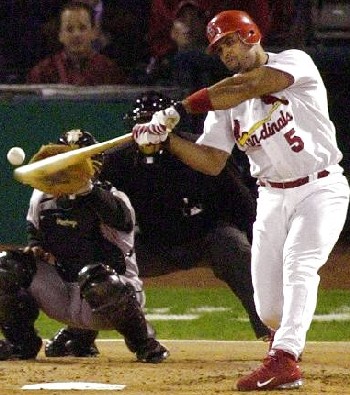
So now we come to perhaps the most important of the three elements: interaction. Think back to our hypothetical encounter between Albert Pujols and Carlos Zambrano. 

The outcome of this at-bat does not depend solely on their respective individual abilities, or even on the contact between Zambrano's pitch and Pujols' bat. It turns instead on how each of them interprets what they perceive to be the other's thoughts and likely behavior. Likewise with Pujols' expectations of the fielders: what do they think that I'm thinking about what they will do?

The manner in which this interactive dynamic plays itself out becomes ever more complex depending on the situation. With two outs and nobody on base in an early inning, the dynamic is relatively simple. With each addition to the situation, however, the complexity increases and so does the importance of all those myriad interactions: between pitcher and batter, between batter and fielders, between fielders and runners, between runners and base coaches, between the managers, etc.

This is probably pretty elementary to baseball fans, and probably not very surprising to non-fans. How can we use this notion of interaction to think about the economy?

Conventional ways of talking about the economy frequently ignored the effects of interaction. For decades, economists analyzed things almost exclusively in terms of stand-alone individuals with given, even unchanging, abilities and preferences. Yet just as growing research in fields like genetics and neuroscience has demonstrated that interaction can give rise to both personality (nature and nurture) and consciousness (the interactions among neurons), so too has economics recently discovered the importance of interaction.

The magnitude of this realization in economics is well documented in David Warsh's Knowledge and the Wealth of Nations: he chronicles the growing awareness among economists, over a period of twenty years, that things like learning, technological progress, and even economic growth all come down to interaction. Here, for example, is Nobel laureate in economics Robert Lucas, who pioneered the "rational expectations" turn in economic thought: "But we know from ordinary experience that there are group interactions that are central to individual productivity and that involve groups larger than the immediate family and smaller than the human race as a whole. Most of what we know we learn from other people. . . . We know this kind of external effect is common to all the arts and sciences--the 'creative professions.' All of intellectual history is the history of such effects. But, as [Jane] Jacobs has rightly emphasized and illustrated with hundreds of concrete examples, much of economic life is creative in much the same way as is art and science."

In this essay and others, Lucas exemplifies the belated academic recognition of "the influences people have on the productivity of others." Indeed, we've probably intuitively known this for all of human history, except in economic analysis. I would submit that this has stunted everyone else's understanding of economic change.

It's not just interactions among individuals that matter, of course: firms interact with one another and with government regulators, and everyone interacts in one way or another with the rules and the ever-present dark matter (uncertainty). The upshot is that any economic prediction you read that is based on past behavior (which is all of them) bears this fatal flaw: it simply cannot account for the various actions and interactions that determine the dynamic aggregate we call "the economy." Expand that to a global scale and, well, you can see why Alan Greenspan basically thinks the Federal Reserve doesn't matter much anymore.

(Last year in the Wall Street Journal there was a very revealing graphic: they compared the GDP growth predictions of economists with actual GDP growth. Guess what? The economists were nowhere close. Read Taleb if you are looking for harsh words on economists.)

Even if you're not a baseball fan, even if you're not a sports fan in general, you've probably heard the aphorism, "That's why they play the games." The team that looks the best "on paper" is not always (and perhaps only sometimes) the champion at the end of a season. The ultimate result turns on interactions and the unpredictable chains of development they initiate.

We could call those, say, complex and perpetually novel outcomes. Hey! That turns out to be the product of our 'formula," the subject of our next post.

Friday, August 15, 2008

Klosterman Comes Close to Getting It

Since my expository post on Uncertainty, you can see that I have come across a few things relevant to that general theme. One was the Taleb quotation. And now comes this from Chuck Klosterman, one of my favorite writers, in the September issue of Esquire (he is a columnist there). I don't think it's available online yet, so I'll post a few selections here:

"Baseball has--by far--the best scoring system in all of sport. It makes uninteresting contests exciting, because it a) doesn't have a concept of time and b) distributes runs in unorthodox increments. . . . Imagine a 3-0 game in the bottom of the ninth inning: The leading team is clearly in control. But if the leadoff hitter gets a bloop single, the pressure immediately reverts to the pitcher--now, if the next guy gets on base, the game has the potential to be reinvented with one swing. The fact that you can instantly score a variable number of runs (in a game in which scoring is rare) keeps baseball fascinating."

(Admittedly, Klosterman begins this sidebar by saying baseball is a "turgid game that no longer reflects society." Obviously, given the existential premise of this website, I think he's wrong.)

There are multiple levels we could explore here, but I want to initially focus on the one that jumped out at me: a direct link to Mandelbrot's concept of "trading time," a key part of his ideas around fractals in finance. Klosterman points out that in baseball, scoring often occurs in bunches: this not only perpetuates uncertainty but also distorts a "normal" sense of time.

I wonder if a worthwhile statistical analysis would be to chart the distribution of scoring in baseball? Does it occur in bunches? It might make sense given the way a run-scoring rally can build on itself, but I wonder if this might be tied to home run frequency.

Anyway, if run scoring in baseball did occur in bunches, I suppose this might be analogous to the economic phenomenon of innovations often appearing in waves or clusters.

If anyone out there knows if such a statistical analysis has been done, please let me know.

Thursday, August 14, 2008

Our Favorite Curmudgeon on Uncertainty


Nassim Nicholas Taleb, in an interview with Portfolio today:

"The structure of uncertainty in the world is vastly greater than we think."

Dark matter . . . See post of a few days ago.

(I use "curmudgeon" in a friendly sense, of course. I am a huge fan of his.)


Tuesday, August 12, 2008

Baseball as a Teaching Tool

Hmmm . . . on deck, baseball used to teach children about the economy, perhaps?

Baseball Used to Teach Kids About Math and Science


Monday, August 11, 2008

Inequality in Sports

I already mentioned this in a post over at Growthology, where I have the privilege of serving as a guest blogger this week, but I thought it totally pertinent to our project here.

Mark J. Perry at Carpe Diem had this very enlightening post yesterday on home run inequality and team income inequality. He intriguingly notes how the unequal distribution of home run production in any given year matches the unequal distribution of income as documented by the IRS. Perry also had a similar post about the 80-20 rule in NBA scoring.

His point, of course, is that inequality in any human activity, including the economy, is inevitable. Our purview here at Box Score won't always include normative judgments, though I would refer readers to the Friedrich Hayek quotation I posted in the aforementioned Growthology post, as well the Kurt Vonnegut short story.

At some point in the near future we may have a post from Derek applying the insights of Hayek (one of the greatest overall thinkers of the 20th century) to our baseball analogy.

On a final note, the MLB historical stats that Perry used are likely a gold mine for future analysis on this site.

Sunday, August 10, 2008

Formula Elaboration # 2: Uncertainty

Let's say Carlos Zambrano, anchor of the Chicago Cubs rotation, faces St. Louis Cardinals superstar Albert Pujols, in a tight pennant race game. Each player has studied the other: pitch type, pitch sequence, hot and cold hitting zones, direction the ball is usually hit in, etc. When the bases are empty, Pujols has an informed guess of the likelihood that Zambrano will start him off on a fastball low and away. On any given count--1-0, 2-0, 2-1--Zambrano knows that Pujols swings X% of the time. The infield positions itself according to Pujols' directional probabilities, and the outfield will usually play Pujols deep.

Always a game conducive to statistical analysis, the last twenty years have seen a veritable explosion in the statistics used to analyze any possible outcome during a baseball game. Part of this goes under the name sabermetrics (a site we like is Baseball Prospectus), but you can see less mathematical derivations of it during any television broadcast: average with runners on second and third with two out, average with a 3-1 count, ERA during day games, etc.

But no matter how many formulae you throw into a particular situation, like one between Zambrano and Pujols, the outcome always remains indeterminate. It's often said that baseball is a game of inches, and slight differences in the trajectory or spin of the ball, the planar path of the swing, the angle at which the ball and bat meet can have enormous differences. (The "butterfly effect" in a different context.) Pertaining to another sport, David Foster Wallace has written excellently on all the different things that can affect the path of a racquet-launched tennis ball.

All of that is not surprising, but it just goes to show how much uncertainty remains even in a statistical-heavy endeavor like baseball. Moreover, the participants in a baseball game are only human, prone to mistakes and irrational decisions. The beautiful unpredictability of homo sapiens will always create copious amounts of uncertainty.

It also shouldn't surprise anyone that uncertainty is a major factor in the economy. Go back one year to the beginning of what is usually referred to as the "credit crisis." Canvass any news article in the subsequent year and you will continually find expressions of shock at how much we don't know and how murky the future directions of the U.S. and world economies are. It's as if it never occurred to them that uncertainty still lurked. (There are, of course, some hope-inspiring exceptions.)

But what does uncertainty mean? The idea that uncertainty plays a large role in economic affairs has come back into some form of fashion in recent years, mostly due to the fabulous work of Nassim Nicholas Taleb and his books, The Black Swan (the more popular one) and Fooled by Randomness (the better one). Still, Taleb would probably be the first to point out that economists and commentators appear to be consistently surprised at not only the impact of uncertainty but also the mere existence of uncertainty.

I say uncertainty is "back" in fashion because it has been recognized before in economic analysis. Two famous economists in particular, Frank Knight and Joseph Schumpeter, saw uncertainty as a critical element in the economic universe--the dark matter, we might say.

Here is Knight writing in 1921 in Risk, Uncertainty and Profit:

"It is a world of change in which we live, and a world ofuncertainty. We live only by knowing something about the future; while the problems of life, or of conduct at least, arise from the fact that we know so little. This is as true of business as of other spheres of activity. . . . If we are to understand the workings of the economic system we must examine the meaning and significance of uncertainty; and to this end some inquiry into the nature and function of knowledge itself is necessary."

We'll leave the epistemology for the future, or for others (a favorite is Karl Popper). For now it is sufficient to note that Knight insightfully distinguished between two types of uncertainty. Risk, which could be quantitatively measured and thus known and accounted for; and "true" uncertainty, which is non-quantitative and "not susceptible to measurement and hence to elimination." It is this "true" uncertainty--the dark matter--that accounts for the existence of profit and entrepreneurship. (We'll return to entrepreneurship in a future post when we sort out its baseball analogue.)

Speaking of entrepreneurship, Schumpeter was the economist of the entrepreneur--we'll dwell more on this great thinker in the future. Here we'll simply note that Schumpeter placed a great deal of emphasis on "indeterminateness" in economic activity, a line of thought that is well covered in Thomas McCraw's recent biography of Schumpeter, Prophet of Innovation.

OK, so you get the point. Uncertainty rules in baseball and the economy because of the number of things that can affect possible outcomes. If a single play in baseball cannot be worked out or predicted in advance, how much harder is it for businesses and governments in their more complicated environments? This redounds back to the importance of rules, particularly those set forth by governments. Individuals and firms face enough uncertainty as it is--they don't need additional uncertainty created by arbitrary government action.

Perhaps we're consistently surprised by uncertainty because it often masquerades as certainty, or at least predictability, in the form of short-term patterns, for example. The course of a baseball season is often shaped by slumps and streaks. For apparently no reason, a player will suddenly lose the ability to get on base, or will go on a two-week tear. The same happens to teams, and we similar effects in the economy. Stock markets go through stretches of incredible gains or mounting losses; firms can stagnate for extended periods of time.

These short-term patterns can yield a small degree of predictability, and economic models allows us to predict with some confidence the short-term consequences of an action. Yet despite the fact that such patterns are regular economic phenomena and can have identifiable causes, one common trait is that they are usually unforeseen, and sometimes inexplicable.

But we're only human after all: we grasp for any measure of certainty in a world full of the dark matter of uncertainty. As we'll discuss in greater depth later, however, this uncertainty is what creates the opportunities exploited by entrepreneurs in the economic context and what we'll for now call "game-changers" in baseball. In short, uncertainty is a prime source of wealth creation and economic growth.

Or, as Lewis Lapham has written, paraphrasing an Arab proverb: "we have less reason to fear what might happen tomorrow than to beware of what happened yesterday." That's as true in baseball as in the economy.

Saturday, August 9, 2008

Formula Elaboration # 1: Rules

In our introductory post, we set forth the basic formula that expresses the idea of this website:

Rules x Action in the Face of Uncertainty x Interactions of Individuals = Complex and Perpetually Novel Outcomes

Today we begin a brief series of elaboration designed to explain just what we mean by the elements in this formula. Let's start with Rules, or (R) for short. 

(As will become clear, the elements--and anything additional we will later include--are arranged not in chronological order, but in order of what we perceive to be importance in their contribution to the product. That is, we don't think that, when a market economy begins, a council of elders sits down and designs a given set of rules, just as the evolution of baseball doesn't trace itself to a single inventive point in time when someone sat down and made up rules for a never-before-seen game. This is a chicken-and-egg issue and really isn't relevant here.)

Rules are relatively straightforward. Clear rules, both formal and informal, govern a baseball game. Formal rules include foul lines, base paths, the strike zone, the pitching rubber, etc. These provide the basic playing template for the game and are for the most part unchanging. (Critics of the possibly-shrinking strike zone would disagree.) 

The formal rules provide a measure of certainty and are undergirded by informal rules: when a pitcher can knock down a batter, discouragement of stealing bases in late innings when ahead by so many runs, how hard to take out the shortstop during a double play, etc. Tacit and unwritten, informal rules nonetheless help shape the contours of the game.

Market economies are to a great extent self-generating and self-regulating, yet no market economy can function without clear rules and standards. As Financial Times commentator Martin Wolf has written: "Good markets need good governments." Government regulation is, by nature, reactive, but plays a crucial role in structuring economic processes. 

Rules promulgated by government, however, by no means exhaust the rules that provide structure in a market economy. Any type of human behavior occurs in a structure of formal and informal rules. Statutory laws, municipal codes, and accounting standards (often non-governmental) are examples of formal rules. Informal rules can be identified for almost any type of situation: table manners, linguistic conventions, behavioral norms, etc. These can often be unconscious, but still influence our actions. The emphasis within many corporations on "tacit knowledge" is another good example.

Nobel laureate in economics Douglass North is perhaps the most famous name associated with this distinction between different types of rules: he pioneered much of the work, known as new institutional economics, in illuminating the rule structure in which market behavior occurs. Likewise, for a slightly unorthodox but enlightening take on different levels of behavior in the context of economic change, see the work of Geoffrey Hodgson.

No baseball game could be played and no economy could function without rules. But even if you memorized the entire rule book for Major League Baseball, you would have only the dimmest idea of what actually goes on during a game and what determines the outcome of each game. The same goes for the economy: laws and regulations and informal behavioral norms shape economic behavior, but don't really tell you what goes on or how things change.

I suppose this is slightly analogous to the idea that "creativity loves constraints," and you can already see this adumbrating the product (complex and perpetually novel outcomes), but be patient. We next explore the other parts of the formula.