Showing posts with label Uncertainty. Show all posts

Monday, September 1, 2008

In the Long Run

In its nearly one-month existence, this site has mostly focused on elaborating on the basic ideas underlying the 'formula': Rules x Uncertainty x Interaction = Complex and Perpetually Novel Outcomes.

Necessarily, the first wave of posts offered brief overviews of the elements contained here, and probably gave short shrift to some key ideas. Thus, before moving on to more specific and no less important aspects of baseball's economic explanatory power, I just wanted to flesh out what I consider to be key ideas in economic affairs that we haven't adequately addressed. And here we see Uncertainty and Complex and Perpetually Novel Outcomes come together.

The notion that uncertainty plays a huge role in baseball and the economy (we've analogized this further to dark energy in the universe) is pretty straightforward, and it should be said that we don't really mean uncertainty in the basic sense that no one knows what will happen in the future. That's pretty obvious and not very insightful. (Again, though, I'm consistently surprised by economic writings that attempt to move, with little success, from description to prediction.)

We mean uncertainty in the sense that because so many things go into determining the outcome of one pitch or one play in baseball, our predictive power is limited no matter the statistical tools we have at our disposal. A new National Bureau of Economic Research working paper puts this succinctly: "Behavioral outcomes are influenced by hundreds of variables and a near-infinity of circumstances, happenstances, and coincidences." (Via Odd Numbers.) Because, at bottom, both baseball and economic activity involve human behavior, and because humans are (gloriously) imperfect, there is an endless array of things that will affect an outcome. The relatively new field of "neuroeconomics" takes this even a step further than behavioral economics.

Some readers might claim to find here somewhat of an inconsistency: we list Moneyball, after all, as one of our top book choices and isn't that all about greater statistical rigor in player evaluation? Surely we're not casting our lot with Joe Morgan and his anti-Moneyball crusade?

When I critique the utility (pun intended) of statistical models in economics, I am saying that because of the nearly infinite variety of factors that go into determining one individual decision let alone the course of a $13-trillion economy of 300 million people connected to the rest of the world, how can we hope to predict or manage anything? The approach of Moneyball, often distorted to on-base percentage and much-maligned as purely numerical, revolves around going beyond the traditional statistics used to measure player performance (like batting average) and trying to get a more complete picture of what players do that adds value to a team's effort. Simply sizing up a player's abilities (five tools, etc) or looking at batting average were seen to be insufficient. This won't be news to many readers.

But I would bet that Billy Beane and Bill James don't pretend that they can predict or micro-manage the on-field performance of teams and players. They try to raise the probability of certain outcomes and, ultimately, victory, but they know there are plenty of things (dark energy) out of their control. In this sense, all the noise in the financial press over the last two years about the Federal Reserve "engineering a soft landing" for the U.S. economy and the potential impact of the economic policies of the next president likely overstates things.

As an example, let's look at developments over the long-term, and this is where we see uncertainty working on a much larger scale of complex and perpetually novel outcomes. Let's take the entire course of a 162-game baseball season, and the American economy in the twentieth-century. (Disproportionate time scales, perhaps, but a useful way to think about it--you'll see.)

If you reran, as it were, an entire baseball season, it is highly unlikely that you would get the same result as before. The events as they actually turned out were only one possible pathway, not the only possible outcome. Anyone who has played Strat-O-Matic or Statis-Pro can tell you this and won't be particularly surprised by this observation. The developments during the 2008 season are not deterministic: the bounce of one batted ball, a close call at home, a quarter-inch difference in a pitch, a slight change in wind conditions. Any of these could alter a discrete outcome--compounded over 162 games, they could change the character of everything. We often here this expressed during a player's chase or .400. A few years ago wasn't it the case that with something like 16 more hits Barry Bonds would have hit .400? Put aside the steroids accusations and all the walks: sixteen more hits could easily have been attained with a few of the changes just mentioned--a different bounce, a fielder's position, etc.

Baseball is not Calvinistic: there is no predestination. Economic change, too, is not Calvinistic. If you reran the economic history of the twentieth century, nothing guarantees an exact replay of what happened in real life. Sure, we probably still would have ended up with mass production of automobiles, cell phones, and the Internet. But the dynamics of everything would likely be different. Detroit was not the foreordained geographic center of the auto industry. Other states and other countries were vying for that as well. 

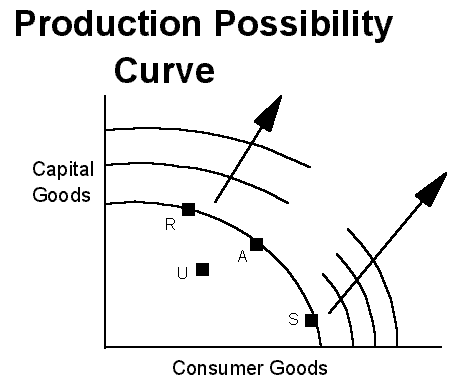
Long-term economic change is often illustrated in economics textbooks by the Production Possibility Frontier, a curve that expands outward as outputs grow. This is a convenient way to depict aggregate economic growth, but doesn't really capture the developmental intricacies of how economic growth feels. Obviously, the point is to represent long-term change in an abstract manner free of potentially-distorting details. But that's like saying at the beginning of a baseball season: some teams will lose, some will win, there will be hits and strikeouts, and at the end there will be one champion. Well, yes that is what happens, but it doesn't really tell us anything about how. Here, in one sense, is an illustration of this. Look at the variety of developmental pathways and niches. Uncertainty and Complex and Perpetually Novel Outcomes are functions of each other.

OK, does this amount to anything more than an observation that contingency plays a large role in baseball and economics? The real payoff is in the implications. We should be careful about applying past lessons to future problems. I would be the first to say let's learn from history, but there's a difference between appealing directly to a past situation and looking instead at the general contours of what has gone before. In this sense, the contemporary debates about whether "Obamanomics" will be like "Clintonomics" or what JFK's tax cuts say about John McCain's economic policies really don't amount to anything meaningful.

We should be more appreciative, in the Popperian sense, of our ignorance: it opens up many more opportunities than a deterministic approach. This is one of the great lessons, for me at least, of David Halberstam's baseball history books: I am consistently surprised in reading them at the unexpected developments, the twists and turns that determined a crucial game or series in 1949 or 1964.

In the next set of posts, we'll begin to take on more specific aspects of baseball and the economy, including entrepreneurship, specialization, long-term dependency effects, and the element of time.

Sunday, August 24, 2008

Ha Ha Ha, Uncertainty, That's a Good One


Evidently, it is a long-standing joke among economists that uncertainty is a known unknown in economic models. At least early psychologists and modern neuroscientists recognize its importance: "It is, in short, the reinstatement of the vague to its proper place in our mental life which I am so anxious to press on the attention."

That is somewhat reminiscent of my earlier-expressed view that uncertainty is sort of like the dark matter of the economic universe. (Or, I guess more accurately today, dark energy.) And that, I admit, should have prompted me to recall the famous Donald Rumsfeld "poetry" about "unknown unknowns."


Friday, August 15, 2008

Klosterman Comes Close to Getting It

Since my expository post on Uncertainty, you can see that I have come across a few things relevant to that general theme. One was the Taleb quotation. And now comes this from Chuck Klosterman, one of my favorite writers, in the September issue of Esquire (he is a columnist there). I don't think it's available online yet, so I'll post a few selections here:

"Baseball has--by far--the best scoring system in all of sport. It makes uninteresting contests exciting, because it a) doesn't have a concept of time and b) distributes runs in unorthodox increments. . . . Imagine a 3-0 game in the bottom of the ninth inning: The leading team is clearly in control. But if the leadoff hitter gets a bloop single, the pressure immediately reverts to the pitcher--now, if the next guy gets on base, the game has the potential to be reinvented with one swing. The fact that you can instantly score a variable number of runs (in a game in which scoring is rare) keeps baseball fascinating."

(Admittedly, Klosterman begins this sidebar by saying baseball is a "turgid game that no longer reflects society." Obviously, given the existential premise of this website, I think he's wrong.)

There are multiple levels we could explore here, but I want to initially focus on the one that jumped out at me: a direct link to Mandelbrot's concept of "trading time," a key part of his ideas around fractals in finance. Klosterman points out that in baseball, scoring often occurs in bunches: this not only perpetuates uncertainty but also distorts a "normal" sense of time.

I wonder if a worthwhile statistical analysis would be to chart the distribution of scoring in baseball? Does it occur in bunches? It might make sense given the way a run-scoring rally can build on itself, but I wonder if this might be tied to home run frequency.

Anyway, if run scoring in baseball did occur in bunches, I suppose this might be analogous to the economic phenomenon of innovations often appearing in waves or clusters.

If anyone out there knows if such a statistical analysis has been done, please let me know.

Thursday, August 14, 2008

Our Favorite Curmudgeon on Uncertainty


Nassim Nicholas Taleb, in an interview with Portfolio today:

"The structure of uncertainty in the world is vastly greater than we think."

Dark matter . . . See post of a few days ago.

(I use "curmudgeon" in a friendly sense, of course. I am a huge fan of his.)


Sunday, August 10, 2008

Formula Elaboration # 2: Uncertainty

Let's say Carlos Zambrano, anchor of the Chicago Cubs rotation, faces St. Louis Cardinals superstar Albert Pujols, in a tight pennant race game. Each player has studied the other: pitch type, pitch sequence, hot and cold hitting zones, direction the ball is usually hit in, etc. When the bases are empty, Pujols has an informed guess of the likelihood that Zambrano will start him off on a fastball low and away. On any given count--1-0, 2-0, 2-1--Zambrano knows that Pujols swings X% of the time. The infield positions itself according to Pujols' directional probabilities, and the outfield will usually play Pujols deep.

Always a game conducive to statistical analysis, the last twenty years have seen a veritable explosion in the statistics used to analyze any possible outcome during a baseball game. Part of this goes under the name sabermetrics (a site we like is Baseball Prospectus), but you can see less mathematical derivations of it during any television broadcast: average with runners on second and third with two out, average with a 3-1 count, ERA during day games, etc.

But no matter how many formulae you throw into a particular situation, like one between Zambrano and Pujols, the outcome always remains indeterminate. It's often said that baseball is a game of inches, and slight differences in the trajectory or spin of the ball, the planar path of the swing, the angle at which the ball and bat meet can have enormous differences. (The "butterfly effect" in a different context.) Pertaining to another sport, David Foster Wallace has written excellently on all the different things that can affect the path of a racquet-launched tennis ball.

All of that is not surprising, but it just goes to show how much uncertainty remains even in a statistical-heavy endeavor like baseball. Moreover, the participants in a baseball game are only human, prone to mistakes and irrational decisions. The beautiful unpredictability of homo sapiens will always create copious amounts of uncertainty.

It also shouldn't surprise anyone that uncertainty is a major factor in the economy. Go back one year to the beginning of what is usually referred to as the "credit crisis." Canvass any news article in the subsequent year and you will continually find expressions of shock at how much we don't know and how murky the future directions of the U.S. and world economies are. It's as if it never occurred to them that uncertainty still lurked. (There are, of course, some hope-inspiring exceptions.)

But what does uncertainty mean? The idea that uncertainty plays a large role in economic affairs has come back into some form of fashion in recent years, mostly due to the fabulous work of Nassim Nicholas Taleb and his books, The Black Swan (the more popular one) and Fooled by Randomness (the better one). Still, Taleb would probably be the first to point out that economists and commentators appear to be consistently surprised at not only the impact of uncertainty but also the mere existence of uncertainty.

I say uncertainty is "back" in fashion because it has been recognized before in economic analysis. Two famous economists in particular, Frank Knight and Joseph Schumpeter, saw uncertainty as a critical element in the economic universe--the dark matter, we might say.

Here is Knight writing in 1921 in Risk, Uncertainty and Profit:

"It is a world of change in which we live, and a world ofuncertainty. We live only by knowing something about the future; while the problems of life, or of conduct at least, arise from the fact that we know so little. This is as true of business as of other spheres of activity. . . . If we are to understand the workings of the economic system we must examine the meaning and significance of uncertainty; and to this end some inquiry into the nature and function of knowledge itself is necessary."

We'll leave the epistemology for the future, or for others (a favorite is Karl Popper). For now it is sufficient to note that Knight insightfully distinguished between two types of uncertainty. Risk, which could be quantitatively measured and thus known and accounted for; and "true" uncertainty, which is non-quantitative and "not susceptible to measurement and hence to elimination." It is this "true" uncertainty--the dark matter--that accounts for the existence of profit and entrepreneurship. (We'll return to entrepreneurship in a future post when we sort out its baseball analogue.)

Speaking of entrepreneurship, Schumpeter was the economist of the entrepreneur--we'll dwell more on this great thinker in the future. Here we'll simply note that Schumpeter placed a great deal of emphasis on "indeterminateness" in economic activity, a line of thought that is well covered in Thomas McCraw's recent biography of Schumpeter, Prophet of Innovation.

OK, so you get the point. Uncertainty rules in baseball and the economy because of the number of things that can affect possible outcomes. If a single play in baseball cannot be worked out or predicted in advance, how much harder is it for businesses and governments in their more complicated environments? This redounds back to the importance of rules, particularly those set forth by governments. Individuals and firms face enough uncertainty as it is--they don't need additional uncertainty created by arbitrary government action.

Perhaps we're consistently surprised by uncertainty because it often masquerades as certainty, or at least predictability, in the form of short-term patterns, for example. The course of a baseball season is often shaped by slumps and streaks. For apparently no reason, a player will suddenly lose the ability to get on base, or will go on a two-week tear. The same happens to teams, and we similar effects in the economy. Stock markets go through stretches of incredible gains or mounting losses; firms can stagnate for extended periods of time.

These short-term patterns can yield a small degree of predictability, and economic models allows us to predict with some confidence the short-term consequences of an action. Yet despite the fact that such patterns are regular economic phenomena and can have identifiable causes, one common trait is that they are usually unforeseen, and sometimes inexplicable.

But we're only human after all: we grasp for any measure of certainty in a world full of the dark matter of uncertainty. As we'll discuss in greater depth later, however, this uncertainty is what creates the opportunities exploited by entrepreneurs in the economic context and what we'll for now call "game-changers" in baseball. In short, uncertainty is a prime source of wealth creation and economic growth.

Or, as Lewis Lapham has written, paraphrasing an Arab proverb: "we have less reason to fear what might happen tomorrow than to beware of what happened yesterday." That's as true in baseball as in the economy.